
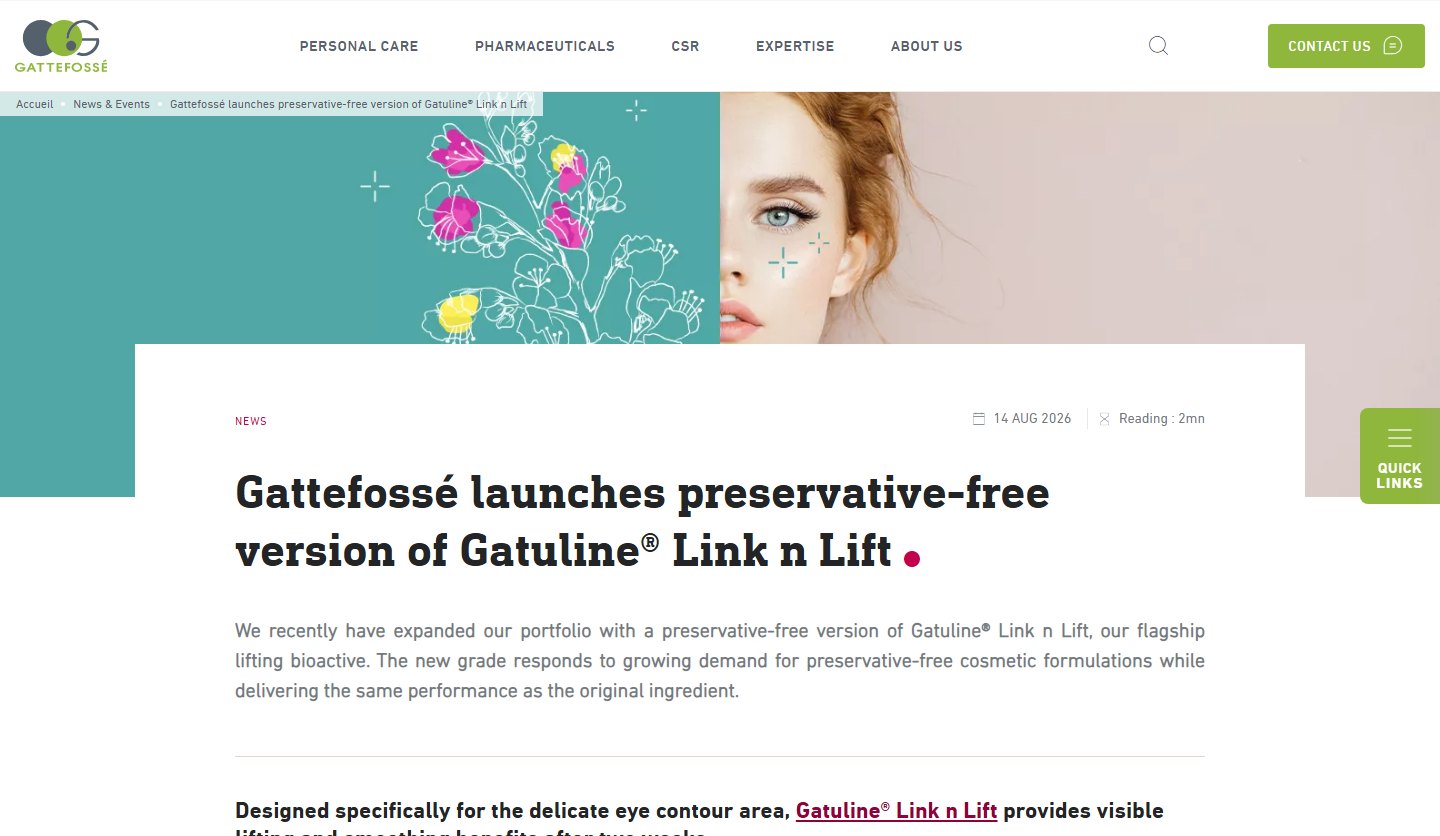
Gattefossé has just done something unusual with a nine-year-old active: it relaunched it with nothing taken out except the preservative. Gatuline® Link n Lift PF, announced on the company’s own news page on 14 August 2026, is the preservative-free grade of an eye-contour bioactive that has been on the market since 2017. Same botanical, same INCI, same 2% use level, same claims — minus the preservative system in the drum. That sounds like a small change. For anyone building a claim file or a preservation strategy, it is not.
Quick answer: what is Gatuline® Link n Lift PF?
Gatuline® Link n Lift PF is the preservative-free grade of Gattefossé’s eye-contour active Gatuline® Link n Lift, announced on 14 August 2026. The ingredient is a horse chestnut (Aesculus hippocastanum) flower extract produced with natural deep eutectic solvent (NaDES) technology, with the INCI Fructose (and) Glycerin (and) Water (and) Aesculus Hippocastanum (Horse Chestnut) Extract. Gattefossé states the PF grade has the same chemical composition, technical specifications and performance as the original, which is used at 2% and supported by a double-blind placebo-controlled study showing visible eye-contour wrinkle reduction in two weeks. Critically, a preservative-free raw material does not produce a preservative-free finished product — that still has to be justified or tested separately.
Key takeaways
- What changed: only the preservative. Gattefossé states the PF grade carries “the same chemical composition and technical specifications as the original version” with equivalent performance in formulations (company-stated, Gattefossé launch announcement, 14 August 2026).
- What it is: INCI — Fructose (and) Glycerin (and) Water (and) Aesculus Hippocastanum (Horse Chestnut) Extract. The sugar and the polyol are not additives; they are the NaDES solvent that did the extraction.
- Use level is published, pH is not: 2% is the studied and recommended level (company-stated, product page). Gattefossé does not publish a pH window, a microbiological specification, or the mechanism by which the PF grade holds without a preservative.
- The trap: 2% of a preservative-free active in a water-based eye cream leaves 98% of the formula still needing a preservation strategy — and adds fructose and glycerin to it.
- Why it matters commercially: the launch is a supply-side answer to retailer and market “no-preservative” screens, and it is COSMOS certified, 99.8% natural origin under ISO 16128, and China NMPA notified (company-stated).
- The real story: the 2026 actives season is increasingly about re-engineering proven molecules for compliance and label screens rather than launching new ones.
Who this is for
Brand owners specifying an eye serum, eye cream or lifting treatment who have been asked for a “preservative-free” or clean-label product, and the formulators and sourcing managers who have to turn that request into a stable, safe, testable finished good. If you are choosing between a preserved and a preservative-free grade of the same active, the decision points below are the ones that actually change your cost, your testing schedule and your claim.
What Gattefossé has actually launched
Gattefossé has launched a second grade of an existing product, not a new molecule. Gatuline® Link n Lift was introduced in 2017 as the company’s first active derived from the horse chestnut flower rather than the more familiar seed or bark. The flowers are organically cultivated and hand-harvested in the Ardèche in southern France, which Gattefossé states is less than 200 km from its manufacturing site — a traceability and footprint argument the company makes explicitly on the product page.
The positioning is structural rather than cosmetic-surface: Gattefossé describes the active as “reconnecting the epidermis to the dermis.” In vitro, the company reports that the extract mobilises fibroblasts in the dermis and reinforces the dermal-epidermal junction (DEJ) by stimulating the synthesis of integrins, laminins, collagens and fibronectin. The DEJ is the anchoring layer between the two skin compartments, and it flattens with age — so a DEJ-focused mechanism is a coherent story for the eye contour, where the skin is thinnest and the visible failure modes are crow’s feet, under-eye wrinkles and tear troughs.
Clinically, Gattefossé reports a double-blind, placebo-controlled study at 2% showing visible wrinkle reduction and skin toning within two weeks. Note what that sentence does and does not contain: it names the design (double-blind, placebo-controlled — the stronger design), the use level and the timeframe, but the public page does not publish the subject number, the measurement instrument or the effect size. That is a normal level of disclosure for a supplier web page and a normal thing to request before you build a claim on it.
The INCI is the solvent: how to read a NaDES active
The most useful thing on the data sheet is the INCI order. Fructose (and) Glycerin (and) Water (and) Aesculus Hippocastanum (Horse Chestnut) Extract tells you that you are buying a sugar-and-polyol system carrying a botanical extract, not a botanical extract dissolved in water.
That is what NaDES means. Natural deep eutectic solvents are mixtures of ordinary plant metabolites — sugars, polyols, amino acids, organic acids — that become liquid at moderate temperature when combined, because of extensive hydrogen bonding between the components. A 2024 overview in Gels, NaDES Application in Cosmetic and Pharmaceutical Fields (Villa et al., Gels 2024;10(2):107), describes them as biodegradable, low-toxicity green solvents whose hydrogen-bond network — and therefore whose solvent behaviour — weakens progressively as water is added, effectively disappearing above roughly 50% v/v water. Gattefossé’s own framing is consistent: it describes NaDES as natural, non-toxic and effective at low temperatures, which is the extraction argument for a delicate flower material.
The practical consequence for a formulator is that the carrier is not inert filler. At 2% you are adding a measurable quantity of fructose and glycerin to your formula, and both do things: glycerin is a humectant with a sensory signature, and fructose is a reducing sugar. Neither is a problem — they are simply variables that belong on the stability protocol rather than in the “carrier, ignore” column.
What “preservative-free” does and does not mean here
A preservative-free raw material is a specification for the drum, not a claim for the finished product. This is the single most important distinction in the launch, and it is the one most likely to be lost between a marketing brief and a bench sheet.
Under EU Regulation (EC) No 1223/2009, a cosmetic product must be safe under reasonably foreseeable conditions of use, and preservatives are regulated by positive list in Annex V. Nothing in that framework obliges a product to contain a listed preservative — but the safety assessment does have to explain how the product stays microbiologically sound for its shelf life and its period after opening. There are two accepted routes:
- Risk assessment — ISO 29621 sets out how to identify products that are intrinsically low-risk (for example anhydrous systems, high-alcohol systems, extremes of pH, or low water activity) and therefore do not need conventional microbiological control.
- Demonstration — ISO 11930 is the challenge test: you inoculate the finished product and show it controls the organisms.
An aqueous eye cream containing 2% of a fructose-and-glycerin active is not obviously an ISO 29621 low-risk product. If anything, the added carbohydrate is a consideration in the other direction. So the honest reading of this launch is narrower and more useful than “now you can make preservative-free eye cream”: Gattefossé has removed one source of preservative from your formula, so the preservative you declare is now entirely your own choice rather than partly inherited from a raw material. For brands whose retail or export screens exclude specific Annex V entries — commonly phenoxyethanol or particular parabens — that is genuinely valuable, because inherited preservatives from actives and extracts are a recurring cause of a formula failing a screen it was never designed to fail.
The open question Gattefossé has not answered publicly is how the PF grade itself holds. A concentrated sugar-polyol NaDES system plausibly has low water activity, and the Gels overview notes some NaDES compositions show antimicrobial activity — but that review does not establish NaDES as self-preserving, and Gattefossé does not publish a mechanism, a microbiological specification or an open-container life for the PF drum. Treat that as a supplier question, not an assumption.
What Gattefossé publishes — and what it does not
Gattefossé publishes more than most principals on the commercial and regulatory side and less than most on the numbers. The table below separates the two so a claim file can be planned honestly.
| Item | Status | What Gattefossé states |
|---|---|---|
| INCI | Published | Fructose (and) Glycerin (and) Water (and) Aesculus Hippocastanum (Horse Chestnut) Extract |
| Recommended use level | Published | 2% |
| Clinical design | Published | Double-blind, placebo-controlled at 2%; visible wrinkle reduction and toning within two weeks |
| Effect size, subject number, instrument | Not published | Request the full efficacy dossier |
| Natural origin content | Published | 99.8% natural origin under ISO 16128; COSMOS certified |
| China market status | Published | NMPA notified |
| pH window / compatibility | Not published | Request the technical data sheet |
| PF grade preservation mechanism | Not published | Request microbiological spec and open-container life |
| Award | Published | 2026 Ringier Technology Innovation Award, China |
The in-vitro mechanism — integrins, laminins, collagens, fibronectin — is marker expression, not a clinical endpoint. It is legitimate supporting science for a mechanism narrative and it is not, on its own, substantiation for a consumer-facing lifting claim. Under Regulation (EU) No 655/2013, which sets the common criteria for cosmetic claims, the evidence has to support the claim as the average consumer will understand it — so the two-week consumer-visible result is the part of the dossier that carries the marketing, and it is the part you should be asking to see in full.
Formulation considerations
The published specification is thin enough that most of the bench work is question-driven. These are the variables that actually differ from a conventional preserved botanical extract.
| Variable | What to plan for |
|---|---|
| Use level | 2% is the studied level. Below it you are off-dossier; above it you are paying for carrier. |
| Carrier load | 2% of a fructose/glycerin system adds humectant and sugar to the formula. Rebalance the humectant budget rather than adding on top of an already-balanced base. |
| Preservation | Design the finished-product system independently. Plan an ISO 11930 challenge test on the final formula, not on the base. |
| Reducing sugar | Fructose is a reducing sugar. Colour and odour drift at elevated temperature, and interaction with amine-bearing ingredients, are standard things to watch on accelerated stability — verify on your formula rather than assuming either way. |
| pH | Not published. Request the window before committing to an acidic serum base. |
| Eye-area safety | Eye-contour products typically carry ophthalmological testing and low-irritation substantiation. Budget it into the pre-first-batch test plan. |
| Incoming handling | A preservative-free raw material generally deserves tighter incoming control and a shorter opened-drum life than a preserved one. Confirm both with the supplier. |
The market angle: reformulation is the 2026 story
The most interesting thing about this launch is that it is not an innovation in efficacy at all — it is an innovation in compliance. Across 2026 the headline actives have mostly been re-engineerings of known chemistry: encapsulated delivery of an established peptide, extraction-technology upgrades, and now a preservative variant of a nine-year-old extract. The molecule was never the bottleneck. Label screens, export dossiers and retailer exclusion lists were.
Three commercial reads follow. First, inherited preservatives are a real sourcing problem — a finished formula can fail a “no phenoxyethanol” screen because of 2% of an active, and a PF grade removes that failure mode at source. Second, China NMPA notification plus COSMOS certification in one ingredient is a deliberately wide net, covering the European clean-beauty channel and the Chinese market that the Ringier award is aimed at. Third, and least discussed, a PF grade quietly shifts work and risk from the supplier to the manufacturer: the preservation problem does not disappear, it moves down the chain to whoever makes the finished product.
For brand owners that is the cost line to watch. “Preservative-free” as a marketing position usually means more finished-product testing, tighter packaging decisions (airless or single-dose rather than open jars), and a shorter or more carefully substantiated period-after-opening — not fewer line items. If you are weighing that against other clean-label routes, our analysis of clean, sustainable and science-backed claims in cosmetics OEM sets out where the cost actually lands, and if you are at the stage of matching this kind of active to a manufacturing partner, start with the OEM moisturiser and face cream manufacturers shortlist.
It also fits a pattern we have tracked all season. Croda’s Matrixyl® Neolide re-engineered delivery rather than the peptide; Ashland’s eternight™ put a new extraction technology behind a familiar botanical; Vytrus’s Toleroxyl™ reframed a mechanism for reactive skin. Gatuline® Link n Lift PF is the same move applied to the formulation constraint instead of the biology.
Questions to send Gattefossé before you specify it
- What is the microbiological specification and the recommended open-container life of the PF grade, and how does it differ from the preserved grade?
- By what mechanism does the PF grade remain stable without a preservative — water activity, pH, the NaDES matrix, or aseptic packaging?
- What is the recommended pH window and the known incompatibilities in a finished formula?
- Can you supply the full efficacy dossier: subject number, instrument, effect size and statistical significance versus placebo?
- Is the two-week result instrumental, expert-graded, or self-assessed — and on which panel populations?
- Does the PF grade carry the same COSMOS certification and NMPA notification as the original?
- What is the retest date and recommended storage for the PF grade?
- Do you have stability data for the PF grade in an aqueous emulsion, including colour over three months at 40°C?
FAQ
Does using a preservative-free active let me claim my product is preservative-free?
No. The claim applies to the finished product, not to one raw material. A product can only be described as preservative-free if it contains no preservative function at all, and its safety assessment must still show it is microbiologically sound for its shelf life and period after opening — either by risk assessment under ISO 29621 or by passing an ISO 11930 challenge test. Using Gatuline® Link n Lift PF removes an inherited preservative from your ingredient list; it does not preserve the other 98% of your formula.
What is the difference between Gatuline® Link n Lift and Gatuline® Link n Lift PF?
According to Gattefossé, the preservative system is the only difference. The company states the PF grade has the same chemical composition and technical specifications as the original and delivers equivalent performance in formulations. The botanical source, the NaDES extraction, the INCI and the 2% use level are unchanged. What may differ in practice is handling: ask specifically about microbiological specification, storage and opened-drum life.
What does NaDES extraction actually mean?
NaDES stands for natural deep eutectic solvent. It is a mixture of common plant metabolites — here sugar and a polyol — that becomes liquid when combined and can extract plant compounds at low temperature without petrochemical solvents. The practical signal for a formulator is that the solvent stays in the product and appears in the INCI, so the sugar and glycerin you see listed are the extraction medium, not added excipients.
Is 2% the right use level for an eye product?
2% is the level Gattefossé studied and recommends, and the two-week clinical result is tied to it, so it is the level a claim can reasonably be built on. Using less puts you outside the supporting data; using more mostly adds carrier. Confirm the level against your own formula and your claims wording before finalising, and ask for the dossier that supports 2% specifically.
Does a fructose-containing active cause stability problems?
Not inherently, but it is a variable worth testing rather than assuming. Fructose is a reducing sugar, and reducing sugars are known to participate in browning reactions with amine-containing compounds, more readily at elevated temperature. Whether that is visible in a given formula depends on the rest of the composition, the pH and the packaging. Put colour and odour on the accelerated stability protocol and read them at three months rather than relying on a general rule.
Why would a supplier relaunch a 2017 ingredient instead of a new one?
Because the constraint that blocks sales has moved from efficacy to compliance. An active with nine years of formulation history and an existing clinical dossier is commercially safer to extend than to replace, and removing a preservative addresses retailer screens, clean-label positioning and export dossiers without restarting the evidence base. Expect more grade-level launches of this kind rather than fewer.
Is there an extra cost to going preservative-free?
Usually yes, though it sits in testing and packaging rather than in the raw material. Preservative-free finished products typically need more microbiological validation, may require airless or single-dose packaging to protect the product in use, and often carry a shorter or more carefully substantiated period after opening. Price the full test and packaging plan before committing to the positioning.
Sources and evidence
- Gattefossé, Gattefossé launches preservative-free version of Gatuline® Link n Lift — the principal’s official launch announcement, dated 14 August 2026.
- Gattefossé, Gatuline® Link n Lift product page — INCI, 2% use level, mechanism, clinical design, COSMOS and ISO 16128 status, NMPA notification, sourcing.
- Villa C, Caviglia D, Robustelli della Cuna FS, Zuccari G, Russo E. NaDES Application in Cosmetic and Pharmaceutical Fields: An Overview. Gels 2024;10(2):107 — peer-reviewed background on natural deep eutectic solvents.
- European Union, Regulation (EC) No 1223/2009 on cosmetic products — safety assessment obligations and the Annex V preservatives list.
- European Union, Regulation (EU) No 655/2013 — common criteria for cosmetic product claims.
- ISO, ISO 11930:2019 and ISO 29621:2010 — challenge testing and microbiological risk assessment.
- Trade coverage: Premium Beauty News, Cosmetics Business and Personal Care Insights.
Limitations
This article is based on publicly available information as of 20 September 2026. OEMHallmark has not tested Gatuline® Link n Lift PF, has not seen the full technical data sheet or efficacy dossier, and has not verified Gattefossé’s clinical results independently. All efficacy figures, certifications and specifications are company-stated unless labelled otherwise. The formulation considerations above are general chemistry and regulatory reasoning applied to a published INCI — they are not a substitute for supplier data or your own bench work. Regulatory positions differ by market; confirm preservative and claim requirements for your own target jurisdictions.
Update history
| Date | Change |
|---|---|
| 20 September 2026 | First published. |
Part of OEMHallmark’s ongoing coverage of new cosmetic actives. If Gattefossé publishes the PF grade’s microbiological specification or a fuller efficacy dossier, this article will be updated and the change recorded above.